
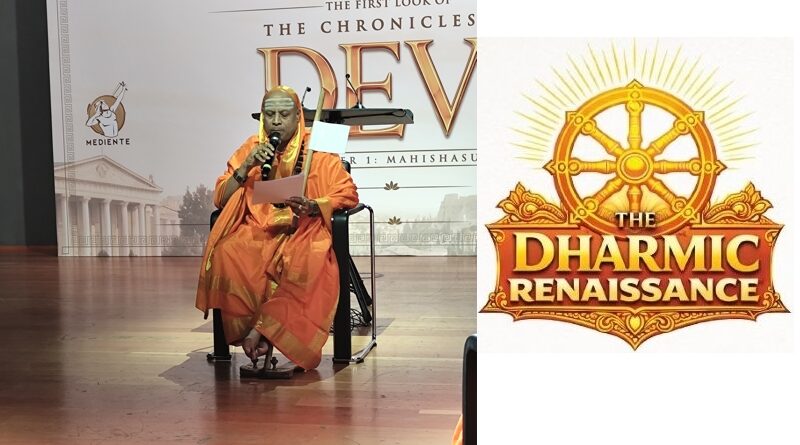
Speech of Paramacharya Jagadguru Sri Sri Sri Jayendra Puri Mahaswamiji in Athens
The speech of Paramacharya Jagadguru Sri Sri Sri Jayendra Puri Mahaswamiji was delivered on April 25, 2026, at the Athens Conservatory, on the occasion of the launch of the Dharmic Renaissance and the Athens Declaration.
ಓಂ ಶಕ್ತಿ ವಿಶಿಷ್ಟ ಪರಬ್ರಹ್ಮಣೆ ನಮ|
ಪಂಡಿತಂ ಪಂಡಿತಾರಾಧ್ಯಂ, ಪಿಂಡಾದಿ ಸ್ಥಲ ಬೋಧಕಂ। ಅಖಂಡಂ ದಂಡವದ್ ವಂದೇ ಸೂರ್ಯಮಂಡಲ ಮಂಡಿತಂ||
With deep reverence, We begin by remembering the sacred Guru lineage of the Srisaila Peetha and invoking the divine blessings of Bhramaramba Mallikarjuna Swamy.
Respected dignitaries, revered scholars, and distinguished guests, We extend our heartfelt respects to all the esteemed participants gathered here today in this holy spiritual assembly in the historic city of Greece. Athence.
Greece is widely regarded as the cradle of philosophical thought, while India is honored as the spiritual guide of the world. It is indeed a rare and meaningful occasion that these two great streams of wisdom are coming together on this sacred platform for reflection and dialogue. Though geographically distant, Greece and India are remarkably close in their philosophical vision.
The great philosopher Socrates, born on this very soil, inspired the world with his profound teachings. His timeless message, “Know yourself,” resonates deeply with the ancient Indian Upanishadic wisdom ‘Atmanam Viddhi’. Both convey the same eternal truth: “Realize your own inner self.”
The tradition that worships Shiva as the ultimate reality-both with form and beyond form, and as the very essence of one’s own self-with a spirit of total surrender, is known as Shaiva culture.
Over time, various forms of worship evolved within this tradition, giving rise to different streams such as Anadi Shaiva, Adi Shaiva, Purva Shaiva, Mishra Shaiva, Shuddha Shaiva, Marga Shaiva, and Veerashaiva, as mentioned in the Agamas. In different regions, these traditions developed unique identities, such as Kashmir Shaivism.
Thus, Shaiva culture spread across the world in diverse forms. Among all these, Veerashaivism stands out as a refined synthesis, integrating the most profound and socially relevant elements of all Shaiva traditions.
Just as Vedanta is the essence of all the Vedas, Veerashaiva philosophy is the essence of all Shaiva paths. Hence, it is said:
“ನ ವೀರಶೈವ ಸದೃಶಂ ಮತಮಸ್ತಿ ಜಗತ್ರಯೇ”
There is no doctrine equal to Veerashaivism in all the three worlds.
The Adi Jagadgurus, the Panchacharyas, propagated this philosophy on earth under the command of Parashiva. Through the Panchasutras, they revealed to the world the profound truths concerning the five fundamental realities: the individual soul, the Supreme, the universe, bondage, and liberation.
Veerashaiva philosophy is founded on the doctrine of Shakti Vishishtadvaita:
“ಶಕ್ತಿಶ್ಚ ಶಕ್ತಿಶ್ಚ ಶಕ್ತಿ, ತಾಭ್ಯಾಂ ವಿಶಿಷ್ಟೋ ಜೀವೇಶ್, ತಯೋರದೈತಂ ಶಕ್ತಿವಿಶಿಷ್ಟಾತಂ”
This means, when a being with limited power develops his power through his own efforts and becomes non-dual with Shiva, who has immense power. its called Shaktivishishtadvaita.
This divine energy is the very cause of creation. While some philosophies interpret this Shakti as Maya, is the reference of; “ಯಾ ಮಾ ಸಾ ಮಾಯಾ”
meance suggesting it separates the soul from Shiva, but Veerashaiva thought offers a deeper insight
‘ಮಂ ಶಿವಂ ಪರಮಂ ಪರಮಂ ಬ್ರಹ್ಮ ಆಯತೀತಿ ಸ್ವಭಾವತಃ । ಮಾಯೇತಿ ಪ್ರೋಚ್ಯತೇ ಲೋಕೇ ಬ್ರಹ್ಮನಿಷ್ಠಾ ಸನಾತನೀ ||”
Here, Maya is not a barrier but a guiding force that ultimately leads the soul back to Shiva.
Just as a mother separates a child from the father at birth only to later unite them again, so too does Shakti separate and reunite the soul with the Divine. Thus, in spirituality, Shakti holds equal importance as Shiva.
It is truly commendable that the Government of Greece has taken the initiative to spread the glory of this primordial Shakti across the world through such a unique and meaningful event.
Veerashaiva philosophy, while deeply spiritual, also carries profound social values. In many traditions, religious rites begin after birth. However, in this tradition, spiritual initiation begins even in the womb through the sacred practice of Linga-dharana.
Unlike certain systems that exclude women from spiritual practices, this tradition grants equal rights, status, and dignity to women in all aspects of religious life, including initiation and worship.
The sacred text Sri Siddhanta Shikhamani declares:
ಬ್ರಾಹ್ಮಣಃ ಕ್ಷತ್ರಿಯೋ ವಾಪಿ ವೈಶ್ ವಾ ಶೂದ್ರ ಏವ ವಾ | ಅಂತ್ಯಜೋ ವಾ ಶಿವೇ ಭಕ್ತಃ ಶಿವವನ್ಮಾನ್ಯ ಏವ ಸಃ ||
This means that regardless of caste, class, wealth, or social status, anyone devoted to Shiva is worthy of the highest respect, equal to Shiva Himself.
Thus, Veerashaiva tradition establishes the highest form of social justice by granting spiritual authority based on virtue and righteous action rather than birth.
Furthermore, this tradition offers a universal gateway for spiritual seekers. Anyone who wishes to embrace the Hindu path finds in Shaiva Dharma a welcoming and profound entry.
One of the most unique contributions of this tradition is the concept of Ishtalinga, which allows every individual to carry the Divine within and worship independently, without dependence on intermediaries.
As expressed:
“ದೇಹೋ ದೇವಾಲಯಃ ಪ್ರೋಕ್ತಃ ಜೀವೋ ದೇವಃ ಸನಾತನಃ”
The body itself is a temple, and the soul within is the eternal Divine.
A young man from Russia, named Danish M, who received initiation from the Jagadguru of Kashi Peetha, once responded to a stranger who asked, “Who are you?” He said with conviction:
“I am a walking temple, talking God.”
Such is the spiritual confidence this tradition instills in its followers.
According to this philosophy, the soul ultimately merges into the Supreme through its union with the Linga-this is called Linga-Anga Samarasyä, or liberation (Moksha).
Interestingly, Greek philosophy echoes similar ideas. When Socrates was sentenced to death, he declared that death is not a punishment for the body but a purification of the soul. This inner purification is what Indian philosophy calls Moksha.
Such profound similarities between our traditions must serve as a guiding message for the world. Let this dialogue foster peace, harmony, and mutual understanding, eliminating hatred and division.
We believe that Greece, by initiating such a noble endeavor and contributing to a rare artistic expression centered on the universal Mother Shakti, is setting a powerful example of global harmony.
May all the future endeavors related to this initiative be completed successfully and auspiciously.
With best wishes to all present here, I conclude my address with blessings.
Om Shanti Shanti Shantih
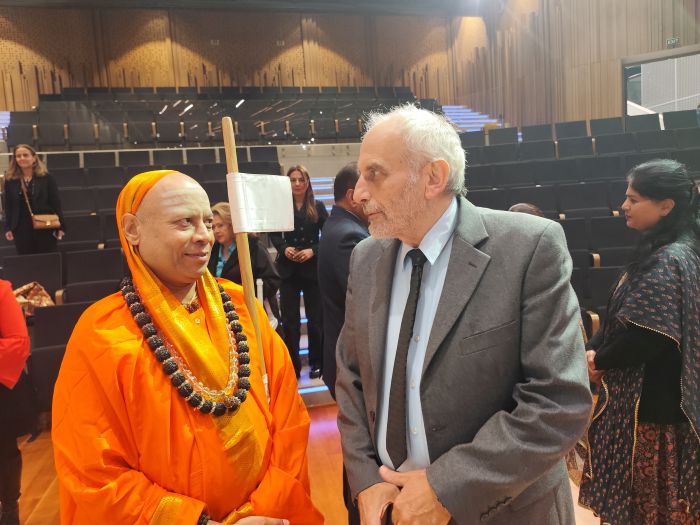
- Paramapujya Srimatparamahamsa Parivrajakacharya Sachidananda Pranavaswarupa Paramacharya Jagadguru Sri Sri Sri Jayendra Puri Mahaswamiji Peetadhipathi, Sri Kailash Ashrama Mahasamsthana.
- Paramapujya Sri Jayendra Puri Mahaswamiji is the successor to Paramapujya Sri Tiruchi Mahaswamigal. Presently, Paramapujya Sri Mahaswamiji is the Peethadhipathi of Sri Kailash Ashrama Mahasamsthana, who has dedicated Himself to bring awareness of Bhaarateeya Sanskruti across the world. Paramapujya Sri Mahaswamiji conveys that Bharateeya Sanskruti has always visualized and fostered the profound divine concept of Vasudhaivakutumbakam – the world as one family.

