
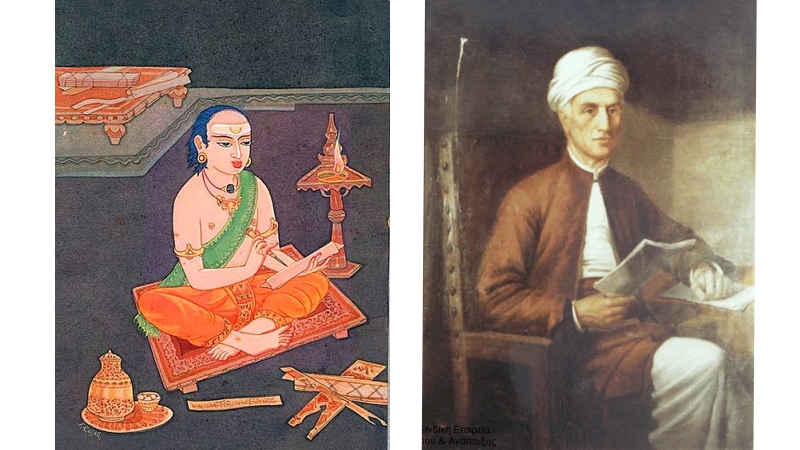
Maybe, not only Sanskrit was created by God …
By A.L. Katonis, Aristotelian University, Thessaloniki, Greece
“There is no reason to believe that only Sanskrit was created by God at the time of creation. When the Yāvaṇa, and so on, were created, their language was also created. We do not have any evidence to show that the Yāvaṇa also first used Sanskrit and only later shifted to their own language.”
Certainly, a trained linguist would not express himself today like either the remark in the title or the one about the language of the Yāvaṇa. An established approach in linguistics has been in existence for about 250 years.
This remarkable observation, however, was made in India in the 16th century. It was the opinion of Annambhaṭṭa, who flourished around 1560. He studied grammar with Śeṣa Vīreśvara while in Kāśī. Vīreśvara is mentioned in one or two grammatical works from later times, but we know of no works attributed to him.[1] For us, Annambhaṭṭa’s remark is of historical interest, and is also proof that with “Yavana” the Greeks were understood.[2]
Annambhaṭṭa is well known to students of the Nyāya system as the author of the most commonly studied introduction, the Tarkasaṃgraha[3], as well as other important treatises. We find his remark, quoted above, in his Uddyotana Commentary on Kaiyata’s Pradīpa. Kaiyata was a grammarian from Kashmir who is believed to have lived around 1200 A.D., and Pradīpa (the ‘Lamp’) was one of his Commentaries on Pāṇini’s Ashtādhyāyī, giving way to their study based on the derivation of words.
The Nyāya system (Nyāya Sūtra-s) is part of Hindu philosophy. The sūtra-s are attributed to Gautama, but many among them may be the work of other authors. What is important is that the sūtra-s focus on knowledge, logic, reason and epistemology, and make no mention of Vedic rituals.
Concerning the Nyāya system and the other names and concepts quoted, many online and hard copy sources are available. Here are some: Max Müller (2020; ©1899, 1919; see pp. 362-431), D.S. Lopez (1995; see p. 21), Stoneman (2019, ©1991; see pp. 362-367), Doniger (2015, ©2009; see p. 185). Those who wish a deeper insight are advised to consult the life-work of Surendranath Dasgupta.[4]
The aim of the present short contribution is not, however, to discuss details of Hinduism either in a narrow or in a broader frame. It is just a hint at a – perhaps – little understood fact, a misunderstanding, and, by our epoch, an indication of only historically rooted importance. The content of the quote could be felt today, simply, an amusing one. Yet, this writer has encountered the above false concepts as confessed, in identical or in similar shapes, both in India and in Greece, not to speak of the many dilettantish phrasings in various countries which, very probably, are spread world-wide either as hoaxes or – put in a milder wording – as folklore products beyond Greek and Sanskrit, and being based on various other languages, preferred by ethnic sympathies.
Historical linguistics and linguistics as a science began with William Jones (1746-1799) whose collected works were first published in 1799. Jones’ person and the related linguistic facts can be studied in many sources like Vassiliades (2000: 1ff.) or Mallory (1989, translated also into Greek). The second one is perhaps the best Introduction to Indo-European, discussing linguistic, archaeological and mythological details. The today preferred term for the older “Indo-European Linguistics” or “Indo-European Studies” is the happier Comparative Philology. The number of the respective works is excessively big. It is not possible here to cite even the most basic introductions, too numerous, which, however, one can find either online or in specialised libraries or in American and in European Universities. Comparative Philology is not an end in itself; it is a reliable co-traveller of both historical linguistics and classical studies as understood as focusing on Greek, Latin and Sanskrit. Frequently, Greek and Sanskrit (Vedic) complement each other linguistically and also beyond.
William Jones’ attempt was, in a sense, similar to that of Michael Ventris, and at the same time, a common mistake of theirs, but which still proves the correctness of the method they applied. Ventris’ huge undertaking, the decipherment of the Linear B alphabet in cooperation with John Chadwick (their book cited frequently as Doc. or Documents), was first published in 1956, and for the second time in 1973 in a vast 622-page work. At the outset, Ventris assumed that he would, if succeeded, decipher an “Aegean” language, say “Pelasgian”, and to his surprise, and to the surprise of many, the language appeared to be an early dialect of Greek, now called “Mycenaean Greek”. Today, the term “Linear B” refers to the writing system of this language, a system which continued the undeciphered as yet Linear A. The two “linear” scripts, after the collapse of the Mycenaean World, disappeared.
Jones’ objective was to reconstruct the “pre-Babel” “common language of Mankind” as described in the Bible. In a search after the concept “eternal”, i.e., why Rome became “eternal” (urbs aeterna) I found that the concept has its roots in pre-Islamic Iran and after transpositions through the Middle East, arrived in Egypt. It is known that Alexander the Great received there the oracle that he should found a city whose fame would remain forever, and this led to the foundation of Alexandria in Egypt. For the Western world, the first city of the “eternal” kind was “eternal Alexandria”. This was later transposed to Rome, the biggest urban centre in Antiquity, and which is, until today, the “città eterna” in Italian. With regard to the quest for “eternal”, I met the issue of the “original language of Mankind” as existing in the frequent expression in Jones ’ epoch, ante turrim, i.e., before the Tower of Babel. Very clearly, the Armenian Movses Khorenatsi reports (History, Book I, Ch. 5) that Noah’s children were transported to the West to a place which is now called “Olympus” (“qui nunc Olympus vocatur”). The complicated task of the correct interpretation of the Biblical names and facts, different from what an average European is used to know, cannot be the task of the present contribution. However, it is in this context that the ante turrim was used repeatedly, e.g., by J.D.G. Richter in his text edition (Berosi Chaldaeorum Historiae, Lipsiae, 1825). Khorenatsi’s Armenian-Latin bilingual text exists, as far as I know, only in a nearly three-hundred-year-old publication, that by the Whistons (1736). So that we do not get surprised by mentioning the Armenians, we should consider how often Mallory writes on the connection between Greeks and Armenians and on a Greek-Armenian-Indo-Iranian continuum.[5] The “Tower” issue, of course, for Mallory is present only in a negative, dilettantish approach in the English-speaking world, and mostly as that of James Parsons’ The Remains of Japhet, published in 1767 in London. But the issue proves how keen the interest in the “original language of Mankind” in the given epoch was.
It was in this way, in quests for the “ante turrim” language, that Jones detected, instead, a “proto-language”. Not one of the whole mankind, this was impossible, but the ancestor language of a very large family of languages from East to West, Sanskrit and Greek among them, which was called for a long time “Indo-European Parent Language”, and in our time more as “Proto-Indo-European”.
His famous announcement is quoted by many sources, and contains the obvious insight: “no philologer could examine them all without believing them to have sprung from some common source which perhaps no longer exists.”[6]
Certainly! The finding was more than important, but the method is recommended; the tool is exactly what both Jones and Ventris had in their comparison. It has little sense to find, e.g., that Latvian and Sanskrit, or Norwegian and Greek, have similarities. This information is not enough: a step-by-step advance is needed. Where, which language family do the one and the other language belong to, in which greater unites do those families belong to, and how to shape their further grading so that we arrive at the possible furthest reconstructible stage. In this quest, it goes without saying, the oldest reachable linguistic layers are the most useful ones. And here, exactly the three most important, foundational and cultured languages are the most helpful ones: Sanskrit, Classical Greek and Latin. Every other Indo-European language is also useful, but depending on what it can offer each time.
One last remark: linguistic reconstruction is much like procedures in science. Linguistics is not literary criticism. Every linguistic fact, written or oral, “beautiful” or “vulgar”, is part of linguistic investigation. Aesthetics is not a requirement. But human language is not only a biological object, but it is also a social contract! This should never be ignored. The result of all these forces will be a beneficial effect. As Chadwick remarked long ago, only interdisciplinarity can offer real results.
So, we admire the acumen of Indian thinkers of the 16th century. A.D., but we do not believe that whichever language, first of all in their present form, was created by a Supreme Being, and certainly not, and, indeed, we agree with Annambhaṭṭa in this, i.e. that he rejects the idea that the Greeks first spoke Sanskrit and “only later shifted to their own language”.
This is what every professional in linguistic issues would confess, Western or Eastern.
Suniti Kumar Chatterji is one among them. He discusses Indo-Iranian and Indo-European in his almost 1300-page History of the Bengali Language (p. 1ff.) and concludes the Additions and Corrections (p. 112) with these words (first published in 1926, and revised in 1971):
“I can also say, in all humility and in all thankfulness-
«nunc dimittis servum tuum, Domine, in pace»:
and
« prajñānânanda-rūpāya ca rasâtmanē,
samarpyatē karma-phalaṃ Tasmāi viśva-vidē satē
Notes
[1] See Coward – Kunjunni Raja 2008: 223.237.
[2] See Vassiliades 2000: 20; Stoneman 2019: 31.212.395ff., and elsewhere.
[3] See Müller 2020: 435-437 and Dasgupgta 2018 I: 330.610.686-690, and elsewhere.
[4] Dasgupta’s five-volume work has been reedited by Rupa in 2018 in three bulky volumes. All of them discuss Nyāya and aspects of it, the first volume offering a comprehensive survey (pp. 274-366). For more, the Indices of the three volumes are to be consulted. The opus is offered to the readers with this message: “The work and ambition of a lifetime is herein humbly dedicated with supreme reverence to the great sages of India, who, for the first time in history, formulated the true principles of freedom and devoted themselves to the holy quest of truth and the final assessment and discovery of the ultimate spiritual essence of man through their concrete lives, critical thought, dominant will and self-denial.”
[5] Mallory 1989: 9-10.11.12 + several footnotes in the end of his book. See also Vassiliades 2000: 17.
[6] Cf. Vassiliades 2000: 14.
References
Chatterji, S.K. 2011.The Origin and Development of the Bengali Language. With a Foreword by Sir George Abraham Grierson. New Delhi: Rupa Publications India Pvt. Ltd. (First published by Calcutta University 1926. First published in three volumes in Rupa hardcover 1985. Second impression in one volume 1993. Fourth impression 2011)
Coward, H.G. – Kunjunni Raja, K. (eds) 2008 Encyclopedia of Indian Philosophies. Volume V. The Philosophy of the Grammarians. Delhi: Motilal Banarsidass Publishers, Private Limited (©1990).
Dasgupta, S. 2018. A History of Indian Philosophy. Vols. I-III. New Delhi: Rupa Publications.
Doniger, Wendy. 2015. The Hindus. An Alternative History. New Delhi: Speaking Tiger Publishing PVT. LTD.
Jones, W. 1799. The Works of Sir William Jones in Six Volumes. Vol. I. London: Printed for G.G. and J. Robinson, etc. and R.H. Evans, etc. (MDCCXCIX).
Lopez, D.S., Jr. (ed). 1995. Religions of India in Practice. Princeton, New Jersey: Princeton University Press.
Mallory, J.P. 1989. In Search of the Indo-Europeans. Language, Archaeology and Myth. London – New York: Thames and Hudson.
Palsule, G.B. 2008. Annambhaṭṭa. In: Coward – Kunjunni Raja: p. 237.
Stoneman, R. 2019. The Greek Experience of India. From Alexander to the Indo-Greeks. Princeton – Oxford: Princeton University Press
Vassiliades, D.Th. 2000. The Greeks in India. A Survey in Philosophical Understanding. New Delhi: Munshiram Manoharlal Pvt. Ltd.
Ventris, M. – Chadwick, J. 1973. Documents in Mycenaean Greek. First Edition by Michael Ventris and J. Chadwick, with a Foreword by the Late A.J.B. Wace (1956). Reprinted with corrections, 1959. Second Edition by John Chadwick. Cambridge: at the University Press.
Whiston, G. and G. 1736. Mosis Chorenensis Historiae Armeniacae Libri III etc. Londini: Ex Officina Caroli Ackers, apud Joannem Whistonum Bibliopolam, MDCCXXXVI (Accedit Tabula Armenia Major).

